Estimation de l'âge facial : comment l'IA lit une photo
L'estimation de l'âge facial prédit l'âge apparent à partir des indices visibles d'un visage. Elle aide à comparer des photos et à comprendre un résultat, mais elle ne prouve ni l'âge réel ni l'identité.

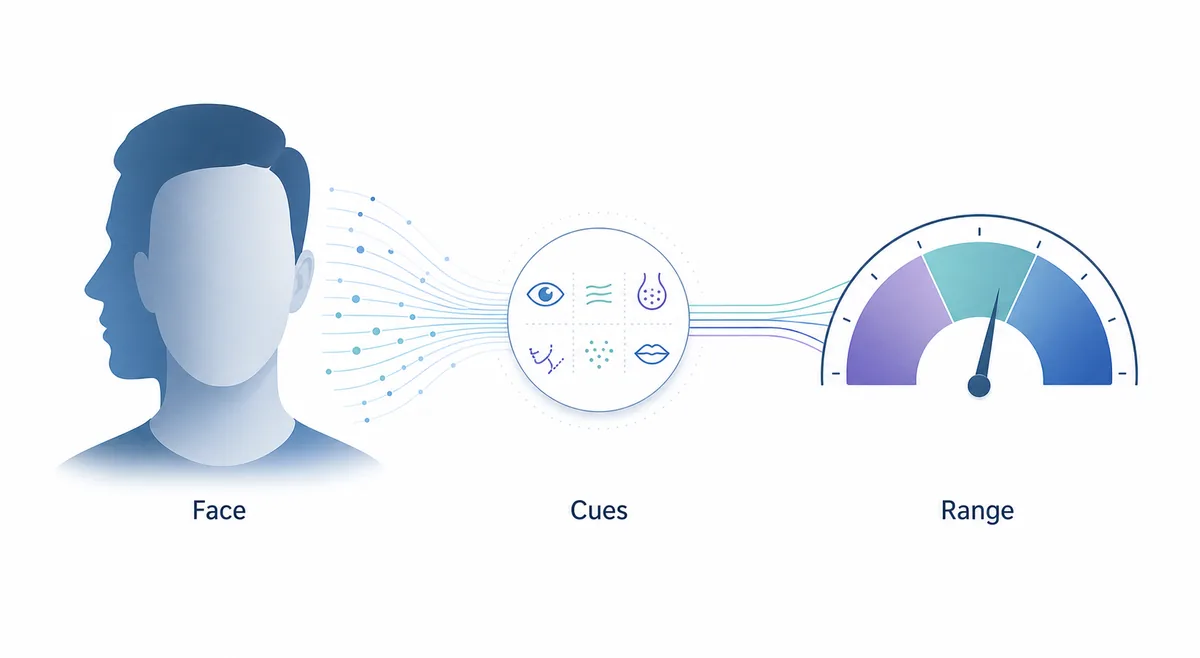
L'estimation de l'âge facial prédit l'âge apparent à partir des indices visibles d'un visage. Elle aide à comparer des photos et à comprendre un résultat, mais elle ne prouve ni l'âge réel ni l'identité. Facial age estimation sits between a fun age guesser and serious biometric analysis. The search intent is usually not just "upload a photo"; readers want to know how a face model reaches an age number, why two photos can produce different results, and whether an estimate can be trusted. The practical answer is that AI age estimation works best as an apparent-age reading for a specific image. It is most useful when the page explains the limits as clearly as the result.
What Facial Age Estimation Means
Facial age estimation is the process of predicting an apparent age or age range from a visible face. A model does not know the person's birthday. It reads patterns in the image: facial proportions, skin texture, eye-area detail, facial hair, makeup, lighting, expression, and image quality. The output is an interpretation of that photo, not a permanent fact about the person.
This is why a trustworthy page should use careful wording. "You look about 30-40 in this photo" is a more honest result than "you are 34." A range gives room for uncertainty and helps users understand that camera angle, blur, filters, and styling can shift the apparent age.
The useful boundary
Facial age estimation answers how old a face appears in one image. It does not prove chronological age, identity, health, maturity, or eligibility for age-restricted services.
How AI Estimates Age From a Face
Most systems follow the same broad sequence. The exact architecture may differ, but the visible user-facing workflow is usually detection, alignment, cue extraction, and cautious interpretation.
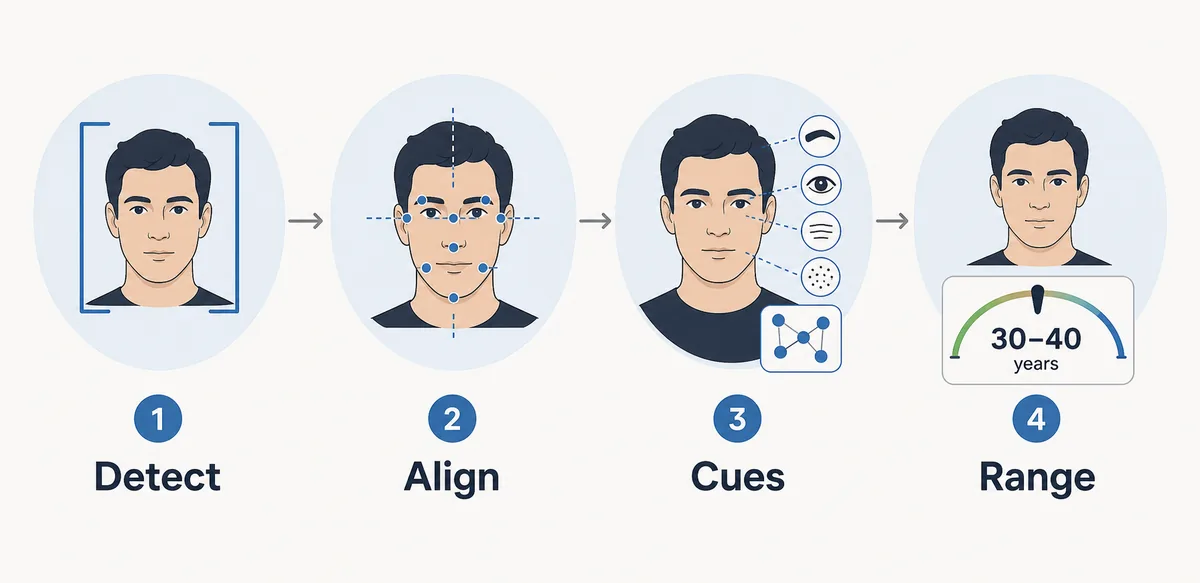
1. Detect and crop the face
The system first finds the face and rejects weak inputs such as tiny faces, side profiles, heavy occlusion, or images with multiple people. If the face is not detected cleanly, the age estimate is already unstable.
2. Align facial landmarks
Landmarks around the eyes, nose, mouth, and jaw help normalize the image. Alignment reduces the effect of tilt and crop, but it cannot fully correct harsh lighting, blur, or exaggerated expression.
3. Read age-related cues
The model evaluates visible patterns such as under-eye shadows, skin texture, forehead lines, cheek volume, jaw definition, hairline, facial hair, and cosmetic presentation. These cues can correlate with apparent age, but they are not equally reliable for every person.
4. Return an age range and confidence
A good age estimator should communicate uncertainty. A range, confidence score, and short explanation are easier to trust than a single exact number with no context.
What Affects Facial Age Estimation Accuracy?
Accuracy depends less on one magic algorithm and more on input quality, training data, and honest output design. The same person can appear younger in soft daylight and older in a compressed, low-light selfie.
| Factor | Effect on estimate | What to do |
|---|---|---|
| Lighting | Harsh shadows can add age cues; soft even light can reduce them. | Use daylight or balanced indoor light. |
| Image quality | Blur, compression, and low resolution hide fine detail. | Upload a sharp portrait where the face is large enough. |
| Expression | Squinting, smiling, or tense expressions change wrinkles and face shape. | Compare neutral and natural-expression photos. |
| Styling | Makeup, facial hair, glasses, filters, and retouching can shift apparent age. | Use an unfiltered image when you want a cleaner reading. |
| Model bias | Performance can vary by age band, demographic group, and source data. | Read the result as a range, not a judgment. |
Facial Age Estimation vs Face Age Verification
Searchers often mix these terms, but they should be separated. Estimation is a low-stakes apparent-age prediction. Verification is a decision process used when a service needs to check an age threshold.
| Topic | Facial age estimation | Face age verification |
|---|---|---|
| Main job | Predicts how old someone appears in a photo. | Checks whether someone meets an age threshold. |
| Typical output | Age range, apparent-age number, or confidence note. | Pass, fail, or review decision. |
| Risk level | Usually low-stakes when used for curiosity or explanation. | Higher-stakes and often policy or law sensitive. |
| Required controls | Photo guidance, privacy notice, limits, and honest wording. | Consent, identity/liveness checks, audit logs, fallback review, and compliance rules. |
Do not overclaim
A casual face age detector should not present itself as legal age verification unless it includes stronger controls such as identity checks, consent handling, liveness checks, audit rules, and fallback review.
Best Use Cases for Facial Age Estimation
The strongest use cases keep the output exploratory. They help users understand photos, compare images, or learn why an age detector result changed.
Photo comparison
Compare profile photos, selfies, or older pictures to see how lighting and expression change apparent age.
Result interpretation
Use an age range to understand why a face age detector returned a younger or older result.
Educational explanation
Explain machine-learning limits without turning the page into a fake compliance product.
Responsible UX
Set expectations before users upload a face photo and point them to privacy details.
Privacy and Responsible Use
A face photo is sensitive. Even when the goal is entertainment, the page should explain how images are handled and avoid claims that sound more official than the product really is.
- State the purpose - Tell users whether the tool gives an apparent-age estimate, a broad age range, or a stronger verification decision.
- Explain image handling - Make retention, deletion, and training-use language easy to find before a user uploads a photo.
- Avoid high-stakes decisions - Do not use a casual estimate for employment, legal access, medical judgment, or identity verification.
Try Facial Age Estimation Safely
If your goal is curiosity or photo comparison, use a face age detector with a clear portrait, good light, and one visible face. Treat the output as an image-specific apparent-age estimate. For a photo-focused workflow, you can also compare results with the guess my age from photo tool.
Frequently Asked Questions
References & Further Reading
- NIST FRTE/FATE age estimation evaluation overview. - View source
- NIST report on first age estimation software evaluation results. - Read NIST update
- Deep learning review on age estimation from faces. - Read review
Last updated: July 5, 2026