AI Age Progression Photo Guide: How It Works and What to Expect
A practical guide to age progression photos, AI future-age previews, provider choices, photo preparation, and the limits of predicting how a face may change over time.

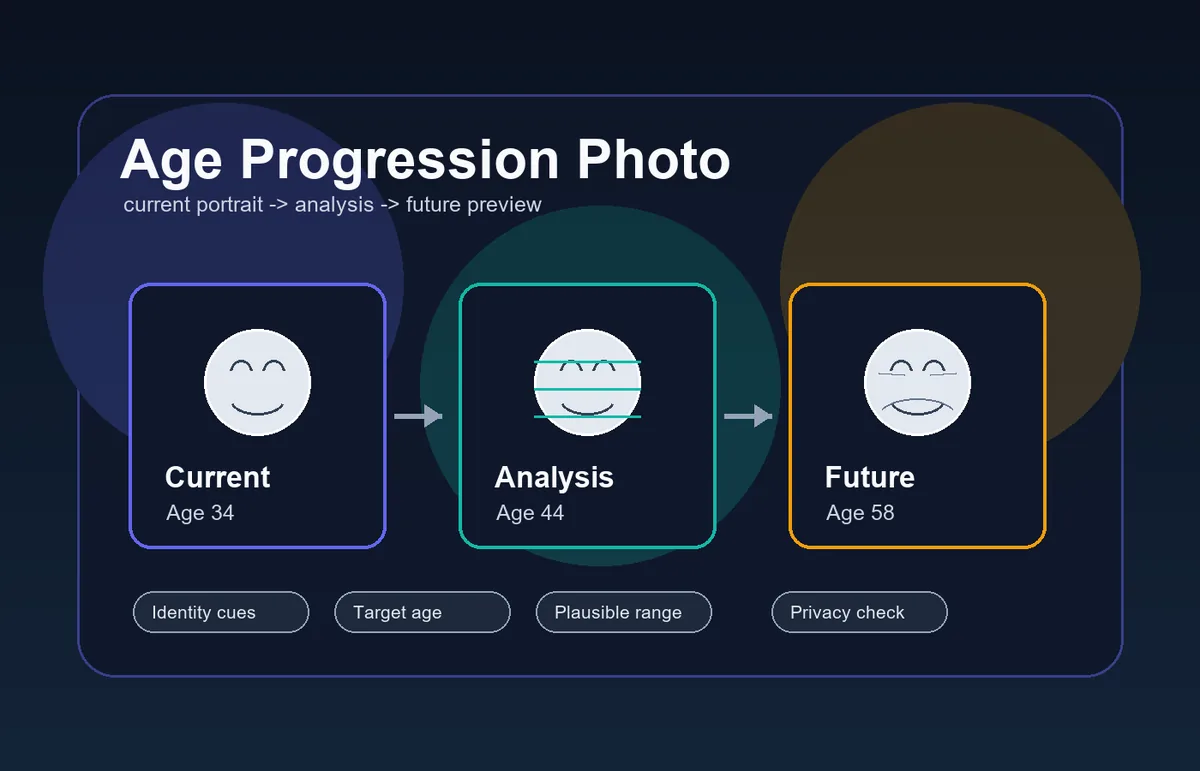
Searches for age progression photo, AI age progression, and who does age progression photos usually come from two different needs. Some people want a fun future-age preview from a selfie. Others need to understand professional age progression for missing-person, family-history, or editorial work. This guide keeps those use cases separate so you can choose the right method and set realistic expectations before uploading a photo.
What Is an Age Progression Photo?
An age progression photo is a visual estimate of how a face may look at an older age. It can be made from one current portrait, several photos over time, family resemblance clues, lifestyle assumptions, or a professional artist's interpretation. The output might be a still image, a before-and-after comparison, or a short age progression video.
The important word is estimate. A future face is shaped by genetics, sun exposure, weight change, health, grooming, facial hair, hairstyle, dental changes, and many ordinary life events. Even a realistic-looking result is a scenario, not a guaranteed forecast.
Use it as a preview, not a prediction guarantee
A good age progression image should show a plausible direction of change while making clear that the real person may age differently.
How AI Age Progression Works From a Photo
Most AI age progression workflows follow the same broad path: understand the face, preserve identity cues, add age-related changes, then render a clean future version.
1. Face detection and alignment
The system finds the face, centers it, and estimates landmarks such as the eyes, nose, mouth, jawline, and forehead. A straight, sharp portrait gives the model more stable geometry to work from.
2. Identity preservation
Useful age progression keeps the person recognizable. It should preserve core proportions, eye spacing, nose shape, facial outline, and other identity cues rather than simply placing a generic older face over the photo.
3. Age cue rendering
The model adds likely age cues such as texture changes, volume shifts, hairline changes, facial softness or definition, and deeper expression lines. Stronger effects are not automatically more realistic.
4. Output review
A believable result should still resemble the input person, avoid distorted features, and match the chosen target age. If the face looks like a different person, the progression has failed even if the image looks polished.
Who Does Age Progression Photos?
The right provider depends on the stakes. Entertainment, creative, editorial, and forensic work should not be judged by the same standard.
| Provider type | Best for | Main limit |
|---|---|---|
| AI age progression app | Fast personal previews, creative images, social comparisons, and low-stakes future-age concepts. | May exaggerate wrinkles, change identity, or hide privacy terms behind a simple upload flow. |
| Retoucher or digital artist | Editorial portraits, family-history projects, memorial images, and controlled before-and-after visuals. | Quality depends on the artist, reference photos, and how clearly the target age is defined. |
| Forensic artist or trained specialist | Missing-person, investigative, or high-stakes identification contexts where review and documentation matter. | Not usually intended for casual personal previews and may require official case context. |
| Photo-to-video generator | Short illustrative aging timelines and social video formats. | Motion can introduce artifacts, identity drift, or unrealistic intermediate faces. |
AI Age Progression vs Manual or Forensic Progression
AI tools are fast and accessible, but manual work can use context that a single-photo model does not know. The decision is less about which method is modern and more about the purpose of the image.
Use AI for quick personal previews
AI is the practical choice when you want a fast future-age portrait for curiosity, creative planning, or comparing how different photos change the result.
Use a trained artist for sensitive work
Artists can consider family photos, known growth patterns, case notes, and human review. That context matters when the image may influence real-world decisions.
Use multiple inputs when possible
A childhood photo, current photo, parent photos, and sibling photos can reduce guesswork. One filtered selfie is a weak basis for a serious future-age result.
Avoid overclaiming accuracy
Neither AI nor manual progression can prove the future. The honest standard is plausible, recognizable, and clearly labeled as an estimate.
How to Prepare a Photo for Better Age Progression
Photo quality has a large effect on age progression results. Start with a clean input before judging the model.
- Use a front-facing portrait - A neutral head angle makes facial proportions easier to preserve.
- Avoid heavy filters - Beauty filters, face reshaping, and strong retouching hide the features a progression model needs.
- Choose natural lighting - Soft, even light shows skin texture and facial structure without harsh shadows.
- Keep the original resolution - Do not crop the face too tightly or upload a compressed screenshot if you have the original photo.
- Compare several photos - Run more than one image when possible. A result that stays recognizable across inputs is more trustworthy than a single dramatic output.
Can You Make an Age Progression Video From a Photo for Free?
Some free or freemium AI apps can animate a single photo through age stages, but the free version usually limits resolution, watermark removal, export length, or daily generations. Treat those videos as creative previews unless the tool clearly explains how it preserves identity and handles uploaded faces.
For better results, generate two or three still age progression images first, then create a short timeline video from those stills. This gives you more control than asking a video model to invent every frame from a single selfie.
Free does not mean low-risk
Before uploading face photos, check whether the service stores images, uses them for training, or requires public sharing. A privacy-friendly workflow matters more than a no-cost export.
Accuracy Limits and Quality Checks
A realistic age progression should be judged by recognizability, restraint, and consistency rather than by how dramatic the aging effect looks.
| Quality signal | What good looks like | Warning sign |
|---|---|---|
| Recognizability | The future face still clearly resembles the source person. | The result looks like a different person with similar hair or age. |
| Age restraint | Age cues match the requested target age and stay plausible. | The model adds extreme wrinkles or gray hair for every older target. |
| Image integrity | Eyes, mouth, teeth, ears, and hairline remain natural. | Features warp, melt, duplicate, or become asymmetrical. |
| Context fit | Lighting, expression, and style remain coherent with the original image. | The output changes pose, ethnicity cues, facial structure, or background in a misleading way. |
The Practical Takeaway
Age progression photos can be useful for curiosity, creative projects, and understanding possible facial changes, but they are only estimates. AI tools are best for quick previews. Professional or forensic work needs more context, human review, and careful labeling.
If your immediate question is how old you look right now, start with a current-photo age estimate. If your question is how you may look later, use age progression as a scenario preview and compare multiple inputs before trusting the result.
Frequently Asked Questions
References & Further Reading
- NCMEC long-term missing resource explaining that forensic artists create age progressions for children missing two years or more. - View NCMEC resource
- NCMEC impact page describing age-progressions, facial reconstructions, and 2025 forensic imaging counts. - View NCMEC impact data
- NIST age estimation evaluation context for understanding limits in automated face-age systems. - View NIST evaluation
- Age Guesser editorial analysis based on GSC data and Similarweb keyword validation on June 10, 2026.
Last updated: June 10, 2026