Age Verification Photo Guide: What a Selfie Can and Cannot Prove
A safety-first guide to photo quality, facial age estimation, privacy, and the difference between a casual age estimate and a real verification workflow


People search for age verification photo, age verification selfie, and age verification picture for very different reasons. Some want to know why a site asks for a clear selfie. Some are comparing facial age estimation tools. Others are trying to understand whether a face scan can prove that someone is over a required age. This guide keeps the boundary clear: a photo can support an estimate, but a serious verification decision needs more than a visible face.
What an Age Verification Photo Can and Cannot Prove
A clear face photo can show visible age cues such as facial shape, skin texture, eye-area detail, facial hair, lighting, and expression. An AI model can use those cues to estimate apparent age or place the face into a broad age band. That is useful for understanding how old a person looks in one image.
The same image cannot confirm a birth date, verify identity, prove consent, or guarantee that the person in the image meets a legal threshold. It also cannot prove that the photo is current unless the workflow includes liveness, timestamps, account checks, document review, or other controls.
Keep the claim narrow
Use photo age analysis for apparent-age feedback. Use age verification language only when the product actually has a policy, consent, privacy, and review workflow behind it.
Photo Quality Requirements for Age Estimation
If a photo is used for facial age estimation, the quality of the image matters more than most people expect. Weak input can shift the result even when the model is working as designed.
| Factor | Good photo | Risky photo |
|---|---|---|
| Lighting | Soft front or side light with visible facial detail. | Backlight, harsh shadows, dark rooms, or overexposure. |
| Face position | One face, front-facing, large enough in frame. | Side angle, tiny face, group photo, or cropped facial features. |
| Image integrity | Recent photo with minimal filters and natural texture. | Beauty filters, heavy retouching, screenshots, or compressed images. |
| Obstructions | Eyes, nose, mouth, jawline, and skin areas are visible. | Masks, sunglasses, hats, hair covering the face, or hands blocking features. |
A Safer Photo-Based Age Check Workflow
A responsible page should explain the role of the photo, what happens to the image, and when the result should be treated as only an estimate.
1. Ask for a suitable photo without encouraging evasion
Request a recent, front-facing, well-lit image with one visible face. Avoid advice that helps people appear older, bypass checks, or manipulate a restricted flow.
2. Separate apparent age from legal age
Show the result as an estimate or age range. Explain that the model reads visible cues in the image, not official records or real identity.
3. State what happens to the image
Users should know whether the photo is stored, deleted after processing, used for training, or shared with third-party processors. Short, plain privacy wording builds more trust than vague promises.
4. Escalate high-stakes decisions
If a decision affects access, payment, regulated content, or account status, a selfie estimate should not be the only control. Use stronger verification and human or policy review where appropriate.
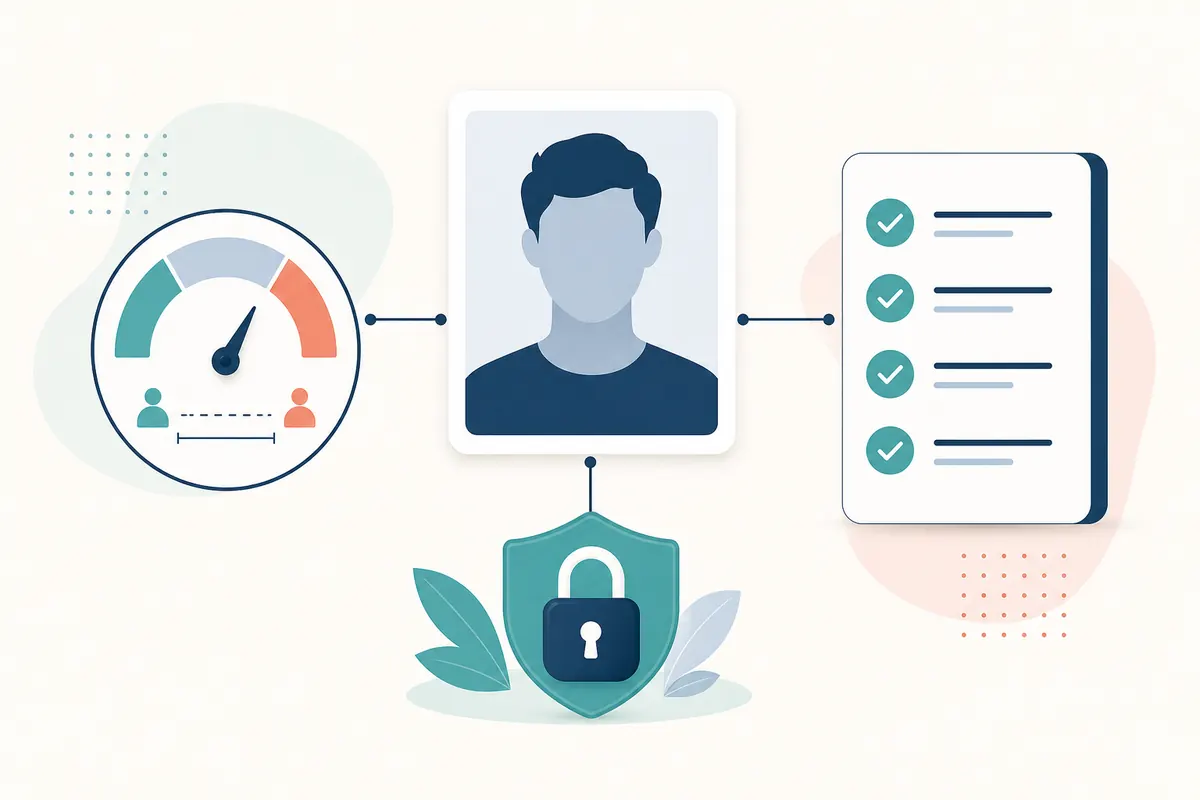
Age Estimation vs Age Verification
The safest way to write about this topic is to make the distinction visible before users upload anything.
| Topic | Photo Age Estimation | Age Verification |
|---|---|---|
| Purpose | Estimate how old a face appears in one image. | Decide whether a person meets a real age threshold. |
| Typical output | Estimated age, age band, or confidence note. | Pass, fail, or review decision. |
| Evidence used | Visible facial cues and image quality. | May include selfie, liveness, ID, policy rules, consent, and audit logs. |
| Best fit | Curiosity, photo comparison, profile feedback, and explanation. | Restricted access, regulated onboarding, or compliance-sensitive workflows. |
Do not promise legal certainty
A photo-first age tool should not claim to verify legal age unless it supports a real verification process with identity, consent, auditability, and fallback handling.
Privacy Risks to Consider Before Uploading a Selfie
Face photos are sensitive. Even when a page is only estimating apparent age, users deserve clear limits and a practical privacy explanation.
- Retention - The page should say whether uploaded images are deleted immediately, stored temporarily, or retained for support, abuse prevention, or model improvement.
- Third-party processing - If an external AI provider analyzes the photo, the page should make that relationship understandable instead of hiding it behind generic wording.
- Sensitive context - Users should avoid uploading images that include documents, private background details, other people, or minors without appropriate permission.
- Misuse risk - A facial age estimate should not be used to shame, discriminate, or make important decisions about a person without safeguards.
How This Applies to Age Guesser
Age Guesser is best understood as a photo-based apparent-age tool. It can help you see how old a face looks in a specific image and why lighting, blur, expression, or styling may move the estimate.
It should not be treated as identity proof or legal age verification. If your goal is curiosity, comparison, or understanding how a photo reads, use the face age detector. If your goal is restricted access or compliance, look for a dedicated verification workflow.
The Practical Takeaway
An age verification photo can be useful, but only within clear limits. It can support apparent-age estimation when the face is visible and the image is recent, clear, and unedited. It cannot prove everything a real age gate may need to know.
For a casual age estimate, use a transparent photo-based tool and read the result as a range. For high-stakes age checks, rely on a workflow designed for consent, privacy, review, and compliance.
Frequently Asked Questions
References & Further Reading
- NIST Face Recognition Technology Evaluation program information on age estimation evaluation. - View NIST evaluation
- NIST May 2024 update on first results from age estimation software evaluation. - Read NIST update
- EFF analysis of age verification, privacy, and speech risks. - Read EFF analysis
- Age Guesser editorial analysis based on GSC data from May 29, 2026 to June 25, 2026 and Similarweb keyword validation in June 2026.
Last updated: June 28, 2026