Can AI Guess Age from a Side Profile? What Research Shows
What a multi-angle study can tell us, why profile views are harder to read, and how to interpret an estimate without treating it as a verified age
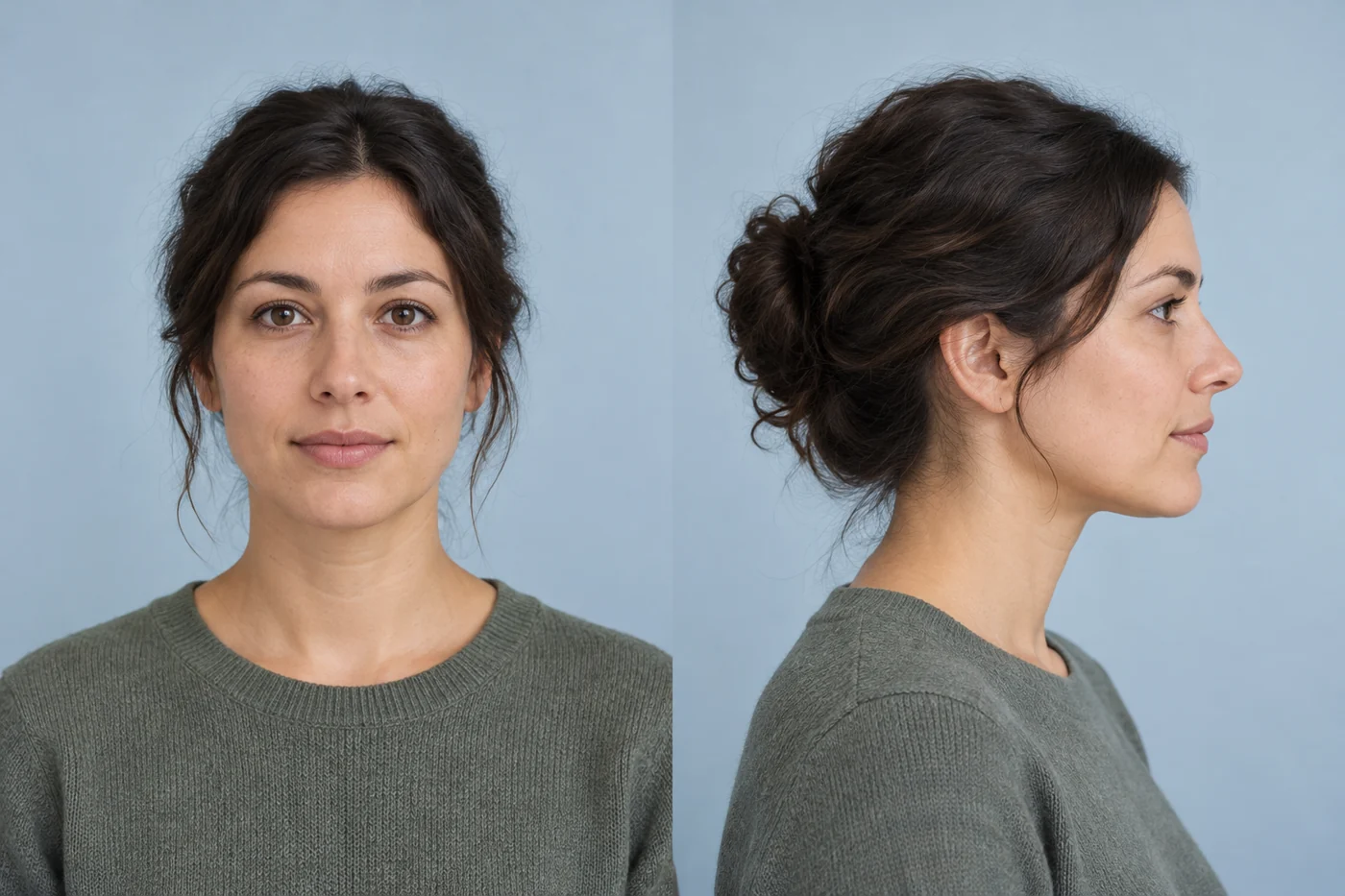
Can AI guess age from a side profile? It can make an estimate from a profile image, but a result is an interpretation of that particular photo. Turning the head changes which facial details are visible, and a model trained mostly on straight-on portraits may not handle a strong profile in the same way.
The clearest evidence comes from a 2026 study that compared front-view, side-view, and paired images. Its results show that side photos can contain useful information, while also showing why a single number should be read cautiously. The study tested specific models on a specific mugshot dataset; it did not certify every online age guesser or predict what one person's result will be.
Can AI estimate age from a side profile?
Yes. A side-view model can learn age-related patterns from visible features such as facial outline, nose and chin shape, skin texture, and the area around the eye that remains visible. Whether it performs well depends on its training examples, the camera angle, the amount of blur or occlusion, and the way its output is evaluated.
A standard photo age tool may be designed around one clear, front-facing face. If it accepts a profile photo, that does not prove it has been tested for profiles. Treat the output as an apparent-age guess for one image, not a measurement of chronological age, health, identity, or eligibility.
Why does a side profile change an AI age estimate?
A profile changes both the visible evidence and the geometry a model sees. Four practical factors help explain why results can move between views.
Less of the face is visible
The far eye and cheek may be hidden, while the nose, lips, and jaw become more prominent. A model cannot use cues that the image does not show, so its estimate may rely on a smaller and different set of details.
Landmarks shift with pose
Eye spacing, nose position, and face width look different when the head turns. Alignment can correct some rotation, but it cannot recreate an obscured side of the face or undo a close camera perspective.
Lighting creates new shadows
Side lighting can cast a strong shadow along the nose, cheek, or eye socket. A model may interpret a shadow as texture, while a bright background can also reduce contrast around the profile.
Training data may favor frontal portraits
If training examples contain mostly straight-on faces, a profile is a less familiar input. A model specifically trained with side views may behave differently, so the tool's intended input matters as much as the pose.
What did the multi-angle age estimation study find?
The paper, “Improving Face Age Prediction by Using Multiple-Angle Photos,” was published in Computational and Structural Biotechnology Journal on April 23, 2026. The authors compared models trained on front-view images, side-view images, and both views together. Their dataset contained paired mugshots, allowing the researchers to compare views from the same people rather than treating unrelated portraits as equivalent.
On the study's test data, the reported mean absolute error was 3.1 years for the front-view model and 3.7 years for the side-view model. A model using a front-and-side pair reported 2.88 years. Mean absolute error is an average across the test set; it does not mean that every estimate was within that many years, nor that an individual result has a known error bound.
| Model input | Reported MAE | What it means |
|---|---|---|
| Front view | 3.1 years | The tested front-view model. |
| Side view | 3.7 years | The tested side-view model. |
| Front + side pair | 2.88 years | Two angles of the same person used together. |
The paper supports a narrow conclusion: side images can carry age-prediction signal, and combining two angles helped the tested models on that dataset. The input pairing and training setup were part of the method. A website that accepts only one upload may use a different model, different data, and different quality checks, so these values should not be transferred to it.
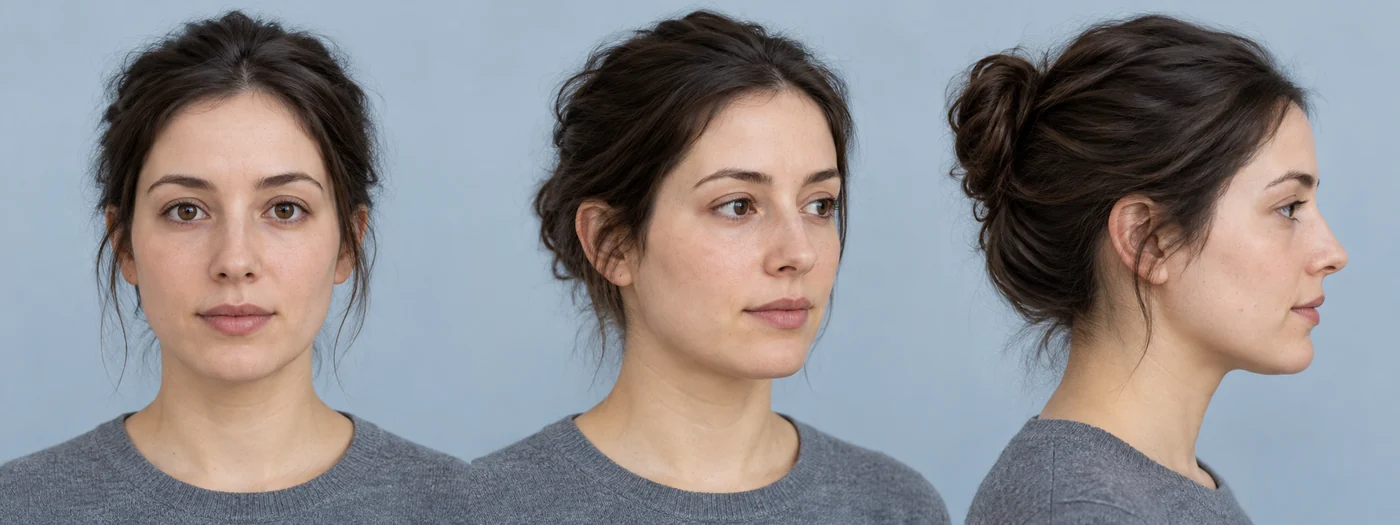
Front view vs three-quarter view vs side profile
There is no universally best angle for every model. The table describes what a photo makes visible, not a promise about how a particular age estimator will score it.
| Photo angle | Visible cues | Practical use |
|---|---|---|
| Front | Both eyes and a balanced view of the face. | A useful baseline when the tool expects a portrait. |
| Three-quarter | Both sides remain partly visible, with more depth. | A natural alternative, but model support varies. |
| Side profile | Face outline and one side of the face; far-side details are hidden. | Use only as an exploratory input unless the tool documents profile testing. |
A three-quarter portrait can retain both eyes while showing more facial depth than a straight-on view, but it is not interchangeable with the paired front-and-side input in the study. Keep lighting and distance similar when comparing photos, and change one variable at a time so you can see what may have affected the result.
How to take a useful side-profile photo
If you are comparing how an AI age guesser handles different angles, use a controlled set of photos. Consistent capture makes the comparison easier to interpret; it cannot make an unvalidated model reliable.
1. Use one person and a simple background
Keep one face in the frame and move hair, hands, or objects away from the visible eye and jaw. A plain background helps the face stand out without pretending to improve the model itself.
2. Choose soft, even light
Face a window or use balanced room lighting. Avoid a bright light behind you and harsh side shadows, which can hide skin detail or create strong edges along the nose and cheek.
3. Keep the camera at face height
Hold the camera near eye level and step back enough to avoid a close-up perspective. Use a natural profile or a modest three-quarter turn rather than an extreme angle that hides most facial landmarks.
4. Keep the image sharp and unfiltered
Tap to focus on the face, use the original image rather than a screenshot, and avoid beauty filters or heavy retouching. Compression and blur can remove details that an estimator might otherwise use.
5. Compare like with like
If the tool permits multiple attempts, use photos taken at roughly the same time with similar lighting and expression. Record the angle and output, but do not interpret a small difference as a real change in age.
Limits: what a profile estimate cannot tell you
An AI age guess from one side profile is a prediction about image appearance. The number can shift even when the person has not changed.
- It is not chronological age. A face image alone cannot verify a birthday or establish identity.
- It is not a universal accuracy score. Performance from a research benchmark may not transfer to another model or photo source.
- It is sensitive to capture conditions. Pose, shadows, distance, expression, blur, and occlusion can all change the visible cues.
- It should not drive high-stakes decisions. Do not use a casual estimate for legal access, employment, health, or age verification.
A useful rule
Read a profile result as a rough, photo-specific estimate. If the output seems surprising, check the image quality and the tool's stated limits before drawing a conclusion about the person.
Try an age estimate with a portrait
For a photo-based estimate, start with a clear portrait and treat the result as a lighthearted interpretation of appearance. Review the site's image-handling information before uploading a face photo.
Frequently Asked Questions
Related guides
- How facial age estimation works - Understand the model workflow and the limits of a photo-based age estimate.
- The science behind apparent age - Learn why a photo estimate is not the same as a verified age.
Source
- Research article comparing front-view, side-view, and paired facial photos for age prediction, published April 23, 2026. Read the study
Last updated: October 24, 2026