Why Do People Look Younger Now? 7 Reasons Old Photos Look Older
The difference is partly real and partly perceptual: lifestyle, preventive care, styling, photography, and the examples we remember all influence apparent age.

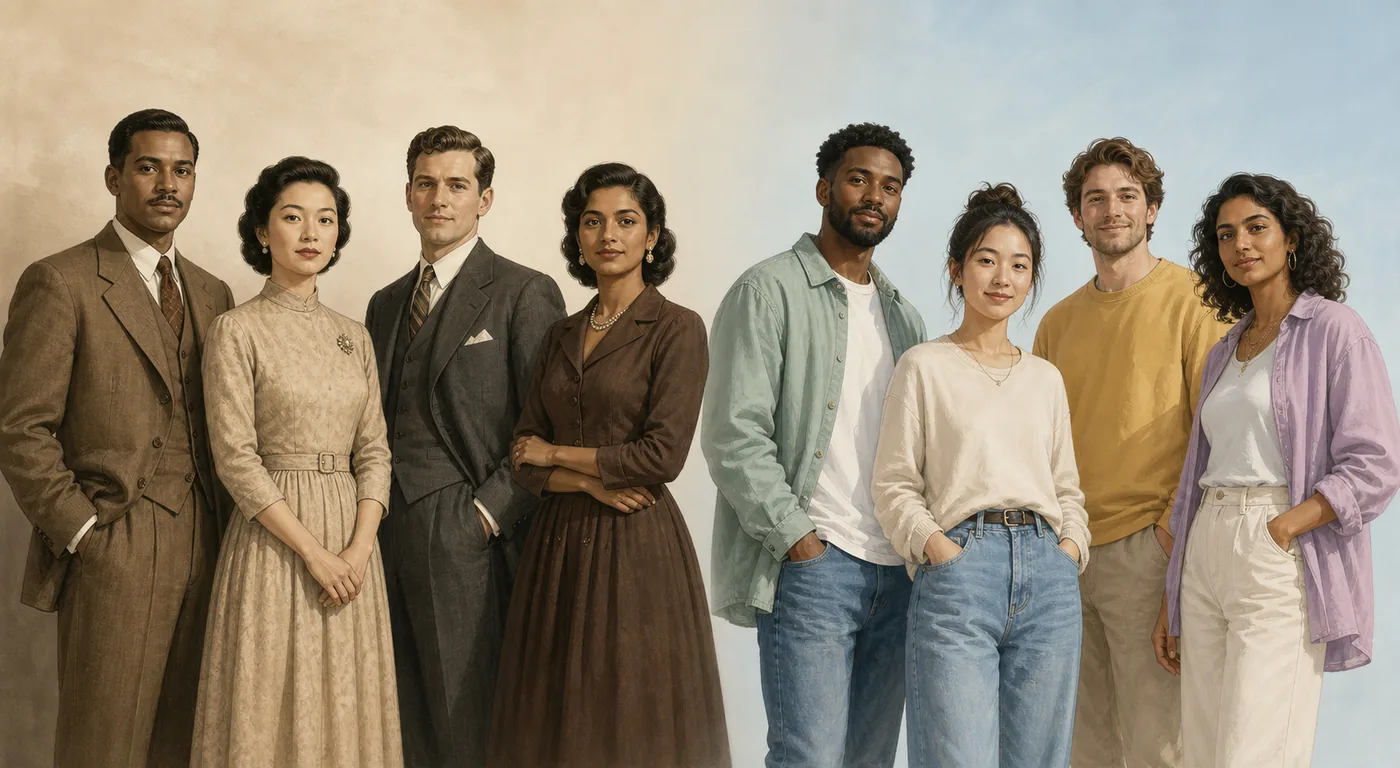
Searches for why people look younger now usually begin with a yearbook, an old television cast, or a family portrait whose subjects seem surprisingly mature. The observation can be meaningful, but a photograph is not a controlled aging study. It mixes real facial and dental changes with clothing, hair, expression, film response, lighting, retouching, and the viewer's cultural expectations. The most accurate explanation therefore separates changes in bodies from changes in pictures and perception.
Do People Really Look Younger Today, or Is It an Illusion?
Both explanations matter. Research on perceived age shows that observers use features around the eyes, skin color uniformity, wrinkles, sagging, and other visible cues. Environmental research has linked higher perceived facial age with factors including smoking and sun exposure. A population study comparing U.S. adults in 1988–1994 with adults in 2007–2010 also found that later cohorts were biologically younger at the same chronological ages on the study's measured indicators, although that does not translate directly into a fixed number of years on every face.
At the same time, the strongest viral examples are not a representative sample. We remember the 22-year-old with a receding hairline, severe expression, formal suit, and harshly lit portrait; ordinary examples attract less attention. That selection effect is one reason to treat a single before-and-now collage as a prompt for investigation, not proof. For more on how visual cues become an estimate, see our guide to the science of apparent age.
7 Reasons People Look Younger Now Than in Old Photos
No single cause explains every decade, country, or person. The strongest account combines seven overlapping changes.
| Factor | How it changes the age impression | Best interpretation |
|---|---|---|
| Fashion and grooming | Can add or remove culturally learned maturity cues | Strong perceptual effect; varies by viewer and era |
| Photography | Light, contrast, grain, expression, and image selection change visible cues | Strong image effect; not a biological measure |
| Smoking and ultraviolet exposure | Can contribute to wrinkling, texture, and uneven pigmentation | Supported environmental contributors; individual effects vary |
| Health, nutrition, and work | May alter long-term wear and some biological measures | Population context, not a promise for every person |
| Dentistry, hair, skin, and vision care | Changes the visual frame around the face | Real presentation effect; access is unequal |
1. Fashion creates an age association
Hairstyles, glasses, makeup, suits, and dresses from earlier decades are now worn mostly by older generations or seen in period media. The brain can mistake an old style for an old face.
2. Portrait conventions changed
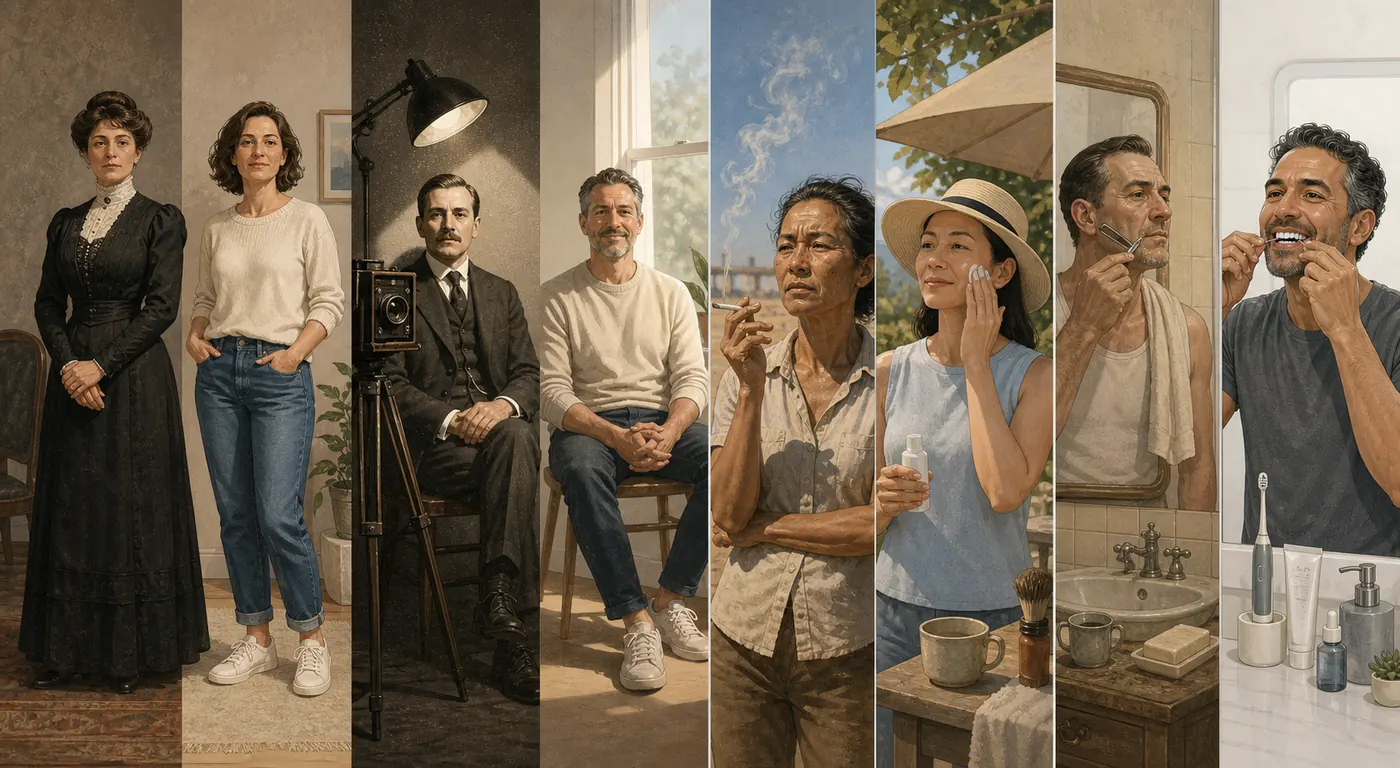
Formal poses, unsmiling expressions, hard light, monochrome contrast, grain, and limited exposure choices can emphasize texture and maturity compared with today's casual, softly lit images.
3. Smoking became less common
Smoking affects blood flow, collagen, oxidative stress, and wrinkling. Lower smoking rates reduce one important source of premature visible aging at population level.
4. Sun protection improved
More awareness of ultraviolet exposure, shade, protective clothing, and sunscreen helps reduce cumulative photoaging, although access and habits vary widely.
5. Dental and vision care changed facial context
Orthodontics, restorations, cleaner teeth, modern frames, and contact lenses can alter the age impression even when the underlying face is unchanged.
6. Health and working conditions improved for many
Better control of some diseases, nutrition and public-health gains, and less heavy outdoor labor can reduce visible wear, but benefits are unequal within and between countries.
7. Grooming, cosmetics, and image selection expanded
Hair color, skin care, cosmetic procedures, higher-volume photography, and selective posting make it easier to present a younger-looking image than when one formal portrait represented a whole period.
Why Old Photos Make People Look Older Than They Were
A style can become an age cue through repeated exposure. If you mainly see a 1970s haircut on people who kept that haircut into later life, the haircut itself starts to feel old. The same applies to thick vintage frames, conservative clothing, dark lipstick, facial hair, and formal posture. This is a context effect, not a flaw in the subject.
Image production adds another layer. A direct flash or hard studio lamp deepens shadows; black-and-white conversion changes color cues; grain and scanning can exaggerate texture; and early portrait customs favored still, serious expressions. Modern phones also create distortions, but users can shoot dozens of frames, choose the softest light, and discard unflattering images. Comparing the one surviving formal portrait with the best of fifty phone photos is not an equal test.
Biological Age Is Not the Same as How Old a Face Looks
Chronological age is time since birth. Biological age is a research concept estimated from physical or molecular measures, and there is no single universally accepted clock for every purpose. Apparent or perceived age is an observer's estimate from visible information. These three numbers can move together, but they are not interchangeable.
A lower population-level biological-age measure in a later cohort does not mean every modern person will look younger, and an AI age estimate cannot diagnose biological aging. A face may appear younger because of light, styling, facial structure, or skin surface while other health measures tell a different story. That distinction prevents a culturally interesting pattern from turning into an unsupported health claim.
The Pattern Is Real for Some Groups, Not a Universal Rule
Exposure, occupation, income, pollution, health care, food security, stress, climate, and beauty norms differ sharply. Some modern conditions may work in the opposite direction, including sleep disruption, chronic stress, air pollution, and unequal access to preventive care. The comparison also changes by age: teenage styling, midlife skin changes, and older-adult health do not follow the same visual rules.
Avoid using old photographs to judge a person's health or life, and avoid using a younger appearance as proof of better habits. Looking young is not a moral achievement. If your interest is practical rather than historical, our companion article explains how to look younger in photos without unrealistic promises.
How to Compare Old and Modern Photos More Fairly
A better comparison controls what can be controlled and openly labels what cannot.
- Match age and setting — Compare people at documented ages in similar contexts—school portrait with school portrait, not a work ID with a vacation selfie.
- Separate styling from facial structure — Temporarily ignore hair, glasses, clothing, makeup, facial hair, color treatment, and background before judging skin or facial shape.
- Use several examples — A group, archive, or repeated set is more informative than one viral image. Note image quality and do not infer health from appearance.
Test the image, not your worth
If you compare apparent-age results, keep camera distance, light, crop, and expression consistent with our photo age comparison tool.
Bottom Line
Why do people look younger now? Part of the answer is material: less smoking for many groups, better sun awareness, preventive health care, dentistry, grooming, and different working conditions. Part is perceptual: old fashion, portrait customs, image quality, and selection bias make the past look older. The honest conclusion is not that modern people have defeated aging, but that apparent age is produced by bodies, environments, cameras, and culture together.
Frequently Asked Questions
Evidence and Further Reading
- A critical overview of fashion bias, smoking, sun exposure, and modern presentation: McGill Office for Science and Society
- Population research comparing biological-age indicators across U.S. cohorts: Is 60 the New 50? (PMC)
- Study of facial skin attributes associated with perceived age: International Journal of Cosmetic Science
- Study of environmental factors associated with facial aging: Age and Ageing